Four Models


Possible Real-life Meanings of XX - Random Variable​

  • Time to event
  • Survival time after cancer diagnosis
  • Time in remission
  • Recovery time after surgery
  • Dollar amount of an auto insurance claim
  • Dollar payment on a medical malpractice policy in one year
  • Number of claims submitted in six months

Cumulative Distribution Function (CDF)​

Definition

The cumulative ditribution function is also called the distribution function. It is usually denotes as FX(x)F_X(x) or F(x)F(x), for a random variable XX. It represents the probability that XX is less than or equal to a given number. That is FX(x)=Pr(X≤x)F_X(x)=\mathrm{Pr}(X\le x). The abbreviation cdf is often used.

F(x)=Pr(X≤x)=FX(x)F(x) = \mathrm{Pr}(X\leq x) = F_X(x)
  1. 0≤F(x)≤10\leq F(x)\leq 1

  2. Non-decreasing

  3. Right-continuous lim⁡x→x0+F(x)=F(x0)\displaystyle \lim_{x \to x_0^+}F(x)=F(x_0)

  4. lim⁡x→−∞F(x)=0\displaystyle \lim_{x \to- \infty} F(x)=0, lim⁡x→∞F(x)=1\displaystyle \lim_{x \to \infty} F(x)=1


Survival Function​

Definition

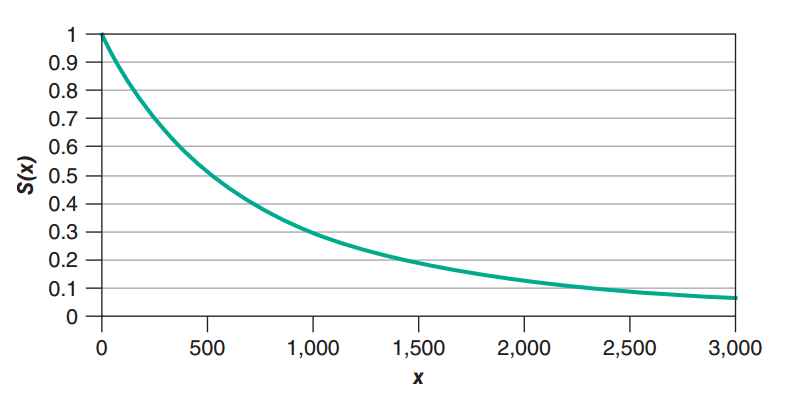
The survival function, usually denoted as SX(x)S_X(x) or S(x)S(x), for a random variable XX is the probability that XX is greater than a given number. That is,

S(x)=1−F(x)=Pr(X>x)S(x)=1-F(x) = \mathrm{Pr}(X>x)
  1. 0≤S(x)≤10\leq S(x)\leq 1

  2. Non-increasing

  3. Right-continuous lim⁡x→x0+F(x)=F(x0)\displaystyle \lim_{x \to x_0^+}F(x)=F(x_0)

  4. lim⁡x→−∞S(x)=1\displaystyle \lim_{x \to- \infty} S(x)=1, lim⁡x→∞S(x)=0\displaystyle \lim_{x \to \infty} S(x)=0

Exponential Survival Function​

S(x)={1,x<0e−x/θ,x≥0\begin{equation} S(x) = \left\{ \begin{array}{lr} 1, & x < 0 \\ e^{-x/\theta}, & x\ge0 \end{array} \right. \end{equation}

Probability Density Function (PDF)​

f(x)=F′(x)=−S′(x)f(x) = F'(x) = -S'(x) if derivative exists


Hazard Function​

h(x)=f(x)S(x)=lim⁡δ→0Pr(x<X<x+δ)/δPr(X≥x)=lim⁡δ→01δPr(x<X<x+δ∣X≥x)h(x) = \frac{f(x)}{S(x)}=\displaystyle \lim_{\delta \to 0} \frac{\mathrm{Pr}(x<X<x+\delta)/\delta}{\mathrm{Pr}(X\ge x)}=\displaystyle \lim_{\delta \to 0}\frac{1}{\delta}\mathrm{Pr}(x<X<x+\delta|X\ge x)

h(x)=f(x)S(x)=−S′(x)S(x)=−ddxln⁡S(x)h(x) = \frac{f(x)}{S(x)} =\frac{-S'(x)}{S(x)}=-\frac{d}{dx}\ln S(x)

S(x)=e−∫0xh(t)dtS(x) = e^{-\int_{0}^{x}h(t)dt}

  • Cumulative Hazard

    Λ(x)=∫0xh(t)dt\Lambda(x) = \int_{0}^{x} h(t)dt